How to Review a Trade Honestly
The trade review is the highest-leverage habit in self-directed trading. It is also the most commonly done badly, because the natural review process — replay the chart, rationalise the outcome, move on — has almost no signal.
An honest review has three sections and takes about fifteen minutes.
Section 1 — Reconstruct the decision (5 minutes)
Look only at the information that existed at the moment of the entry. Zoom the chart to that moment. Read the thesis you wrote at entry. Read the counter-argument. Read the invalidation level.
Ask one question: given only this information, was the decision to open the trade consistent with my rules?
If yes → good decision, regardless of how it turned out. If no → bad decision, regardless of how it turned out.
This is the single hardest discipline in trading. Winners with bad decisions and losers with good decisions are the norm, not the exception.
Section 2 — Reconstruct the management (5 minutes)
Same rules, applied to every review point in the trade:
- Did the stop move? Why? To structure or to comfort?
- Was there a scale-out at the planned level? If not, why?
- Was the exit at target, at stop, discretionary, or thesis-invalidation?
Rate the management the same way: consistent with rules, or not.
Section 3 — Extract one lesson (5 minutes)
Not five lessons. One.
Write a single sentence that captures the transferable lesson. If it is trade-specific (“should have exited earlier on TSLA”), it has no value. If it is process-level (“I move stops to break-even too fast when I have a small cushion”), it feeds the plan for next week.
Add it to a running one-page rules diff. Every Friday, decide whether any items in that diff become permanent rule changes.
What honest review is NOT
- A P&L recap.
- A hindsight rewrite of the entry thesis.
- A screenshot of the “obvious” bar that was clearly the top.
- A generic “I need to be more patient” self-scolding.
How EI ALGOS helps
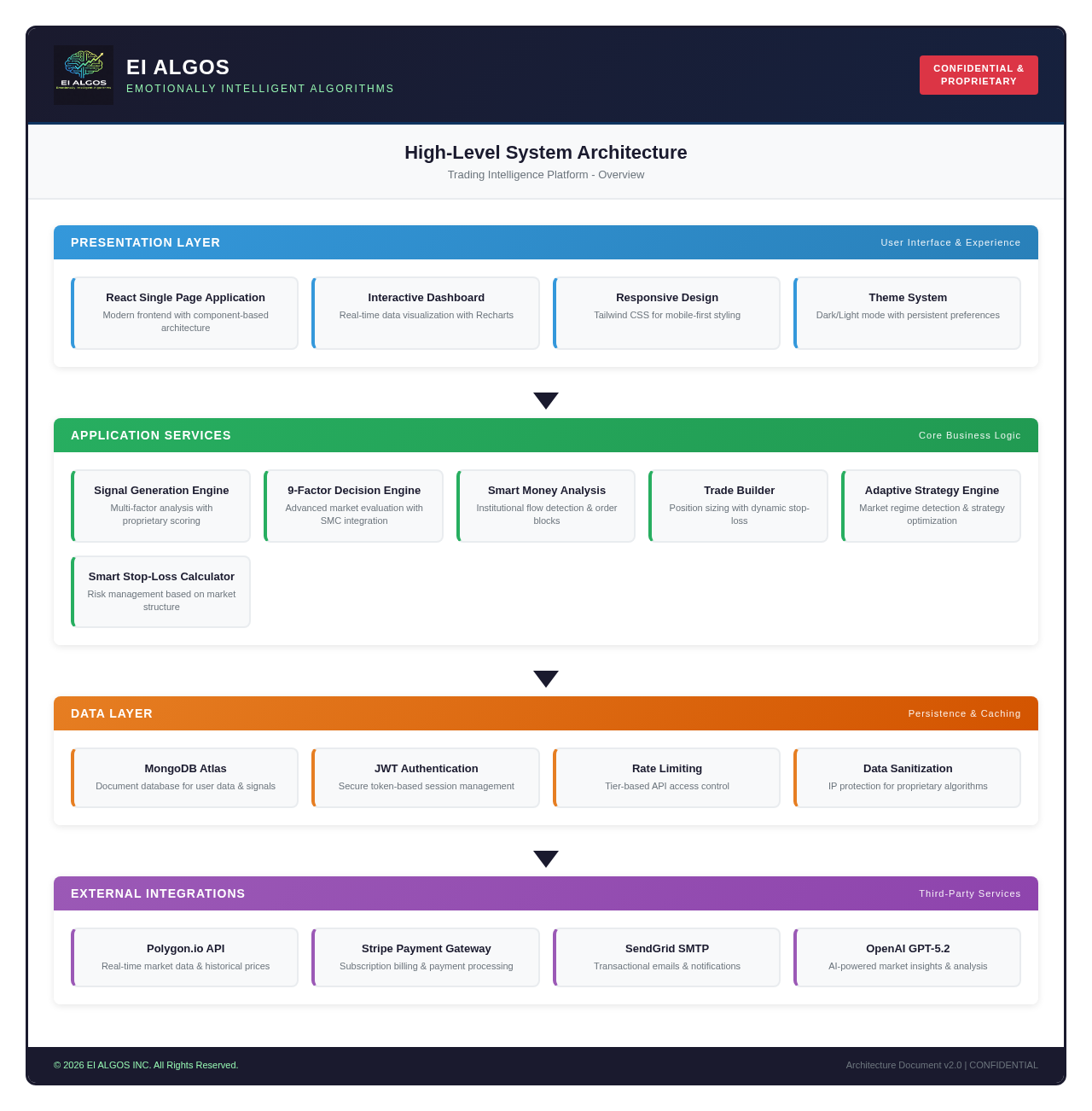
The Decision Score is locked at entry, so the review always references the entry-time thesis and score — not a rewritten one. LIANA can query across many trades to surface aggregate lessons. The Trading Journal is designed around this three-section flow.
EI ALGOS is an educational decision-support platform. Nothing in this article is investment advice.
Related reads
How Professional Traders Manage Emotion
Professional traders are not emotionless — they are structurally protected from acting on emotion. Here is what actually works, drawn from prop firms and institutions.
Deliberate Practice for Traders
Ten thousand hours of screen time does not make a trader. Ten thousand hours of *deliberate practice* does. Here is what that actually looks like.
How to Write a Trading Plan You Actually Follow
Most trading plans fail not because they are wrong, but because they are unfollowable. Here is the minimum structure of a plan that survives contact with the market.
What Is Position Sizing Discipline?
Position sizing discipline is the single highest-leverage rule in a self-directed trader's process. Here is what it means, why it matters, and how to enforce it.