How to Score Every Trade Before You Click: A Step-by-Step Guide
Every successful discretionary trader has an internal scoring system. They just don’t call it that. They feel which setups are A+ and which are C-. The problem: feelings drift with mood, sleep, and the last three P&L points. Discipline erodes.
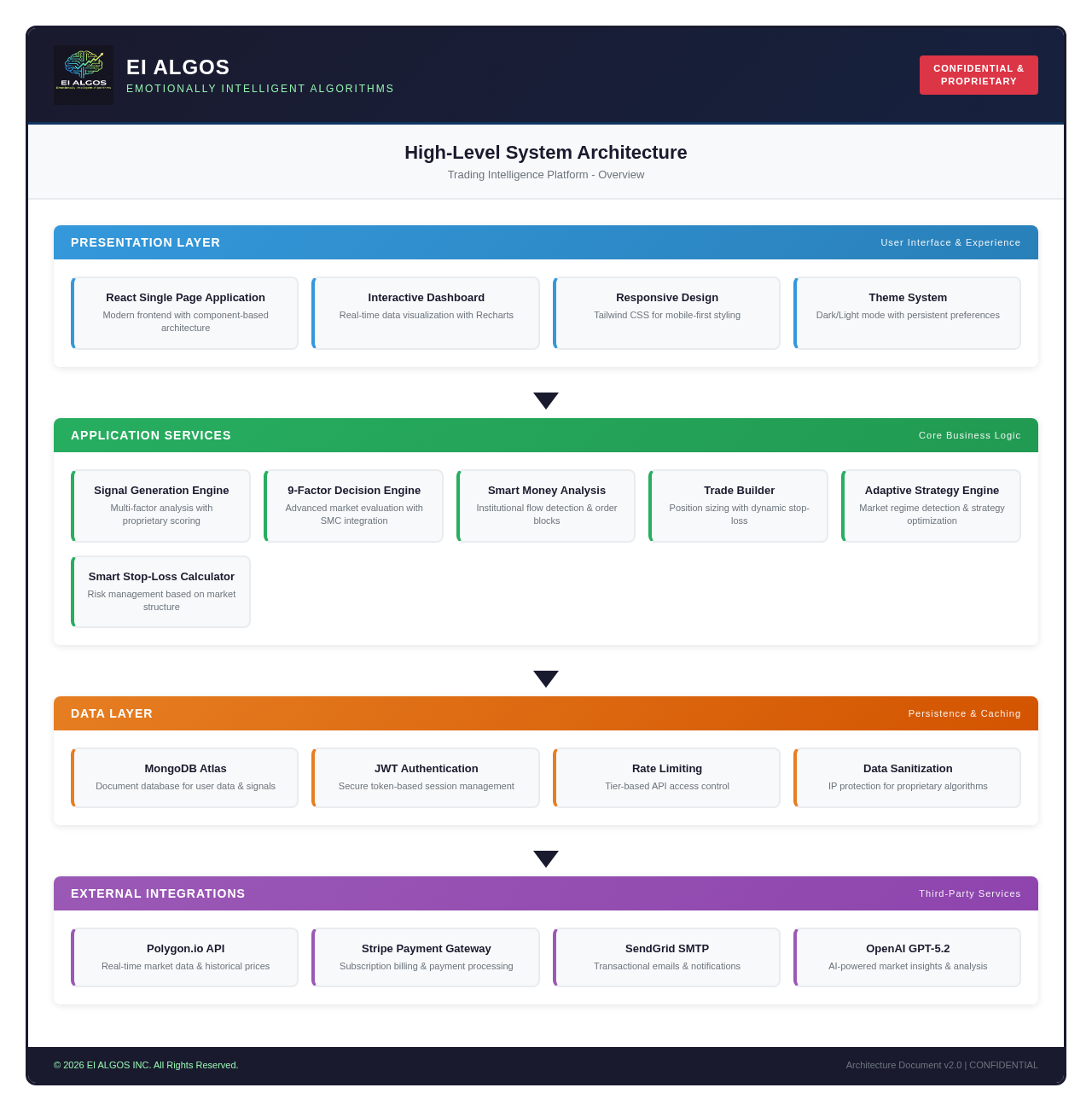
This guide walks through a repeatable, 6-factor scoring method you can apply to every trade before you click. It is the same method EI ALGOS’ Decision Engine uses internally. You can run it in your head, on paper, or let the platform run it for you.
Prerequisites
- 5 minutes per trade idea
- Your trading plan (written)
- Your risk-per-trade rule
- Access to a chart of the instrument
- Optional: your journal of last 20 trades
Step 1 · Score Setup Quality (0-100)
Question: How clean is the technical or structural setup?
For a swing trader: does the price structure show a clear pattern (breakout, retest, reversal at a key level)? For an options trader: does the underlying context (IV rank, term structure, event calendar) match the strategy? For a momentum trader: is there confirmed volume and follow-through?
Scoring rubric:
- 90-100 → textbook setup with clean structure, high timeframe alignment, and clear invalidation
- 70-89 → good setup with minor blemishes
- 50-69 → workable but not clean; needs additional confluence to justify entry
- Below 50 → skip it
Trap to avoid: don’t score high just because you want it to be a good setup. If you’re rationalising, the setup is <70.
Step 2 · Score Confluence (0-100)
Question: How many independent signals align on this idea?
A single indicator saying “buy” is not confluence. Three unrelated forms of evidence pointing the same way is confluence.
Examples of independent evidence: - Price structure (support/resistance, trend, pattern) - Market regime (risk-on vs. risk-off macro state) - Sector/peer alignment - Options positioning (put/call ratio, IV skew, dealer gamma) - Fundamental catalyst (earnings, guidance, news)
Scoring rubric:
- 90-100 → 4+ independent signals aligned
- 70-89 → 3 independent signals aligned
- 50-69 → 2 independent signals aligned
- Below 50 → 1 or 0 signals — this is just a hunch
Step 3 · Score Risk/Reward (0-100)
Question: How favourable is the payoff structure?
Two inputs: - Reward-to-risk ratio (R:R) — target profit divided by stop-loss distance - Probability of win (P) — realistic honest estimate
Scoring rubric:
- 90-100 → R:R ≥ 3:1 with P ≥ 40%
- 70-89 → R:R ≥ 2:1 with P ≥ 45%
- 50-69 → R:R ≥ 1.5:1 with P ≥ 50%
- Below 50 → R:R below 1.5:1 OR P below 50% — bad math
Trap: don’t fudge P upward to hit a threshold. Use your historical hit rate for this pattern. If unknown, assume 50%.
Step 4 · Score Confidence (0-100)
Question: How well do you typically execute this exact pattern?
This is the metric most traders never measure. It requires a journal.
Scoring rubric:
- 90-100 → you’ve traded this pattern 20+ times with positive expectancy
- 70-89 → 10-19 trades with positive expectancy
- 50-69 → 5-9 trades; results mixed
- Below 50 → 4 or fewer trades — this is a learning trade, size accordingly
If you can’t score this factor honestly, that is your answer: you’re gambling, not trading.
Step 5 · Score Execution Discipline (0-100)
Question: Are you about to follow your written plan on this trade?
Sub-questions: - Position size within your risk-per-trade limit? (yes/no) - Entry level clearly defined? (yes/no) - Stop-loss placed and honoured? (yes/no) - Target defined? (yes/no) - Exit rules for both win and loss defined? (yes/no)
Scoring: 5/5 = 100. 4/5 = 80. 3/5 = 60. 2/5 = 40. 1/5 = 20. 0/5 = 0.
Rule: if any of the five is no, stop and fix it before scoring further. You cannot execute discipline you don’t have.
Step 6 · Score Behavioural State (0-100)
Question: Are you in a good state to make this decision?
Check-in questions: - Slept ≥ 6 hours? (yes/no) - Emotional baseline calm (not angry, not euphoric, not desperate)? (yes/no) - Traded within your session limit today? (yes/no) - Last trade wasn’t a loss you’re now trying to revenge? (yes/no) - Not chasing something you missed? (yes/no)
Scoring: 5/5 = 100. 4/5 = 80. 3/5 = 60. Below 3/5 = 0-40.
Rule: if this factor scores below 60, close the platform. The single most consistent finding in behavioural finance research is that state dominates every other factor. A great setup traded in a bad state is a bad trade.
The composite Decision Score
Take the six factors and average them (weighted equally for a first pass — traders can adjust weights over time based on which factors correlate most with their winners).
Interpretation:
- 85-100 → A-grade trade. Take it at full size.
- 70-84 → B-grade trade. Take it at half size.
- 60-69 → C-grade trade. Paper trade it or skip.
- Below 60 → Skip. Wait for a better idea.
Running the loop
The point isn’t to gate every trade behind a spreadsheet. The point is to run the six factors in your head before every click. After 100 iterations, it becomes automatic — and your unconscious scoring gets sharper.
EI ALGOS does this scoring for you in the Trade Builder. You paste in the idea, the platform scores each factor with rationale, and you see the composite before the click. You retain the decision; the platform enforces the discipline.
What to journal after the trade
For each trade, record: - Composite score at entry - Score per factor - Outcome (P/L and R multiple) - What you got wrong or right
Over 50 trades, you’ll find that certain factors predict your winners better than others. Adjust weights accordingly. That’s how the model gets personalised — one trade at a time.
Common failure modes
- Anchoring — you scored the idea 82 five minutes ago; now the price moved against you and you want to re-score down to 65 so you can exit. Don’t. The score is set at entry.
- Retro-fitting — you decided to take the trade for gut reasons, then scored it 85 to justify. Score first, decide second.
- Cherry-picking factors — you skip Behavioural State because you don’t like the answer. That’s the one you can’t skip.
Related reading
- What is Behavioral Decision Intelligence?
- The 7 Trader Archetypes Explained
- Why Signals Fail: A Case Against Push-Based Trading
- See EI ALGOS Pricing
- Read the FAQ
This article is educational. EI ALGOS does not provide investment advice. Trading involves substantial risk of loss.
Related reads
How Professional Traders Manage Emotion
Professional traders are not emotionless — they are structurally protected from acting on emotion. Here is what actually works, drawn from prop firms and institutions.
Deliberate Practice for Traders
Ten thousand hours of screen time does not make a trader. Ten thousand hours of *deliberate practice* does. Here is what that actually looks like.
How to Write a Trading Plan You Actually Follow
Most trading plans fail not because they are wrong, but because they are unfollowable. Here is the minimum structure of a plan that survives contact with the market.
How to Review a Trade Honestly
The trade review is where compounding happens or dies. Here is how to review honestly — separating decision quality from outcome — in fifteen minutes a day.