Emotion Score vs Sentiment Analysis: What's the Difference?
Two terms get thrown around in trading tech that sound similar and are constantly confused: sentiment analysis and Emotion Score. Both mention feelings. Both use the word “emotion” in marketing.
They are completely different things, aimed at completely different problems.
This article draws the line clearly, so you know which one to use when.
Definitions
Sentiment Analysis — a market-level measure. It quantifies how the market as a whole is feeling about a security, a sector, or the broader index. Inputs include social media chatter, news tone, options flow, retail positioning surveys, put/call ratios, and sometimes dealer positioning.
Emotion Score — a trader-level measure. It quantifies how you are feeling and behaving, right now, based on your own trading patterns. Inputs include your trade cadence, deviation from your written plan, revenge-trade signatures, position-size drift, and journal sentiment.
One reads the market. One reads you.
Side-by-side comparison
| Dimension | Sentiment Analysis | Emotion Score |
|---|---|---|
| Subject | The market / a security | The individual trader |
| Inputs | Social media, news, options flow, positioning surveys | Your trades, your journal, your cadence |
| Time horizon | Real-time to weekly | 7-day rolling |
| Actionable output | “Market is greedy → consider fading” | “You are on tilt → step away” |
| Who benefits | Contrarian traders, event-driven traders | Every trader, every session |
| Failure mode | Can be manipulated, false signal | Requires enough trades to calibrate |
| Belongs in the stack | Yes — as a market input | Yes — as a state check |
What sentiment analysis is good for
Sentiment analysis is genuinely useful at extremes. When the AAII survey shows 60% bullish, forward returns tend to be lower. When the CNN Fear & Greed Index shows extreme fear, forward returns tend to be higher. These are well-documented mean-reverting signals.
Sentiment is also useful for spotting information dislocations. If news is negative but price is flat, someone knows something the news doesn’t reflect.
Where sentiment fails: it doesn’t tell you anything about you. A perfect contrarian sentiment signal at a market extreme is worthless if you’re the trader who’s about to take it while on tilt after losing 3% yesterday.
What Emotion Score is good for
Emotion Score is designed for a single question: am I fit to make trading decisions in this session?
It’s answered by looking at:
- Cadence drift — are you trading 3x your baseline today?
- Plan deviation — are you taking setups outside your written plan?
- Revenge-trade patterns — are you re-entering a name that just stopped you out?
- Position-size drift — are your sizes creeping up outside your risk-per-trade rule?
- Journal sentiment — do your recent journal entries show frustration, resignation, or euphoria?
If any of these light up, your Emotion Score drops. When it drops below 60, the platform gently suggests you close it and go for a walk.
Where Emotion Score fails: it needs history. A first-day user has no baseline. It needs 20-30 trades to calibrate. Early in a user’s journey, the Score is directional, not absolute.
Why traders need both
Sentiment answers: what is the market thinking right now? Emotion Score answers: what am I capable of thinking right now?
Both matter. Neither replaces the other.
The best decision-quality stack combines them:
- Idea generation — informed partly by sentiment (fade extremes, ride confirmations)
- Idea scoring — includes market context which references sentiment
- Personal state check — Emotion Score gate before every click
- Execution — if state is fine and idea scored well, take the trade
Sentiment is one input. Emotion Score is the veto. Skip the veto and you’ll take great sentiment signals in terrible personal states — the single most consistent way retail traders bleed alpha.
Common confusions
“So Emotion Score is like a sentiment analysis of me?”
Not exactly. Sentiment analysis is fundamentally about reading opinions. Emotion Score is about reading behaviour. Two very different data streams. A trader can say they’re calm in their journal while their trade cadence has tripled. Emotion Score catches that; a sentiment reading of their journal alone would miss it.
“Isn’t measuring my own emotion just… invasive?”
Emotion Score never reads your webcam, HRV, or biometrics. It only reads your trading activity — the same data your broker sees. It infers state from behaviour, not from surveillance.
“Can’t I just check in with myself?”
You can. You should. But research consistently shows that self-reported emotional state is uncorrelated with actual behavioural drift. Traders on tilt describe themselves as “focused”. The score catches what self-report misses.
Where each shows up in EI ALGOS
- Sentiment inputs live in the Market Intelligence surface — regime, alignment, positioning views.
- Emotion Score lives in the top-right of every page, always visible. It updates continuously.
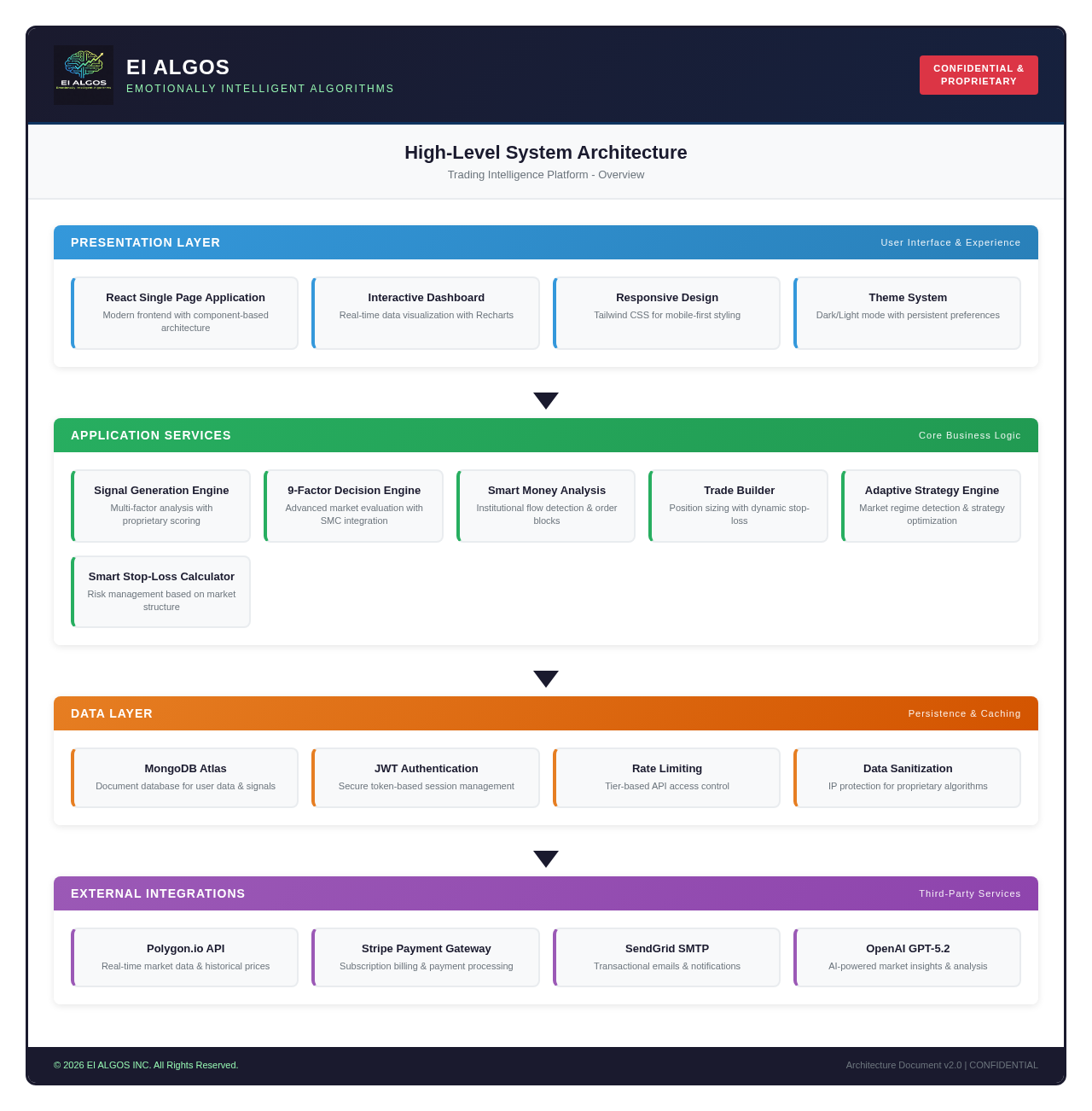
Both feed into the Decision Score. Sentiment sits inside the Confluence factor. Emotion Score is the Behavioural State factor, with veto power at the composite level.
The takeaway
Sentiment analysis is a market lens. Emotion Score is a self lens. Use both. Don’t confuse them. And when the two disagree — market says buy, you say tilt — trust the self lens. Markets always come back. Blown accounts don’t.
Related reading
- What is Behavioral Decision Intelligence?
- How to Score Every Trade Before You Click
- The 7 Trader Archetypes Explained
- Why Signals Fail
- Explore the Knowledge Hub
- See EI ALGOS Pricing
This article is educational. EI ALGOS does not provide investment advice. Trading involves substantial risk of loss.
Related reads
How Professional Traders Manage Emotion
Professional traders are not emotionless — they are structurally protected from acting on emotion. Here is what actually works, drawn from prop firms and institutions.
Deliberate Practice for Traders
Ten thousand hours of screen time does not make a trader. Ten thousand hours of *deliberate practice* does. Here is what that actually looks like.
How to Write a Trading Plan You Actually Follow
Most trading plans fail not because they are wrong, but because they are unfollowable. Here is the minimum structure of a plan that survives contact with the market.
How to Review a Trade Honestly
The trade review is where compounding happens or dies. Here is how to review honestly — separating decision quality from outcome — in fifteen minutes a day.